For years, technology leaders have repeated the same message: “There’s a global tech talent shortage.” It sounds plausible. It feels familiar. And it offers a simple explanation for a difficult hiring environment.
But in many mature European markets, that narrative no longer describes what CTOs are experiencing.
Is there really a tech talent shortage today?
Not in the way most people mean it.
There is no broad shortage of software engineers applying for roles. What many CTOs face is a quality and fit gap: plenty of candidates, but far fewer engineers with the ownership mindset, technical depth, and product thinking needed to deliver meaningful outcomes, especially in mid-market environments.
In other words, hiring is hard not because engineers are unavailable, but because the signal-to-noise ratio is low, and many hiring systems are not designed to identify the right signal.
The narrative is easier than the reality
The phrase “talent shortage” is a convenient conclusion. It simplifies a complex challenge and places the blame outside the organization. But the market has changed.
Here are the three forces keeping the old narrative alive:
- Old assumptions linger – Ten years ago, demand truly did outpace supply. Engineers could choose among multiple offers. Companies hired aggressively to keep up with digital transformation. Many leaders still see the market through that lens.
- Engineers outnumber great engineers – A growing talent pool creates volume, but not necessarily skill depth. Bootcamps, online courses, and accelerated training programs have expanded access but also widened the skill gap.
- Companies see quantity, assume scarcity – Seeing 200 CVs but only one or two suitable candidates feels like a shortage. But it’s a filtering issue, not a supply issue.
Why hiring still feels hard even after layoffs?
Recent layoffs have reshaped the market and increased candidate availability. Public trackers still report substantial tech workforce reductions in 2025, although totals vary by methodology – for example Layoffs.fyi reports 122,549 tech employees laid off in 2025, while TrueUp reports 209,938 people impacted in 2025. But they haven’t solved hiring challenges for CTOs. Why?
Because top performers rarely enter the market through layoffs. In many organizations, leaders actively try to protect mission-critical roles and capabilities during workforce reductions. When companies reduce workforce they often try to retain:
- Highest-performing engineers
- People with essential product knowledge
- Engineers with scarce or highly specialized skills
While the people who are more likely to exit are the mismatched hires or those with narrow or less relevant skills sets. This is not a judgment of individuals. It is a reminder that layoffs are driven by business decisions, not by a market-wide quality rebalancing.
The result is predictable: more CVs, but not a proportional increase in usable talent for roles requiring autonomy, context-switching, and end-to-end responsibility.
The real shortage: Ownership, depth, and product mindset
Most CTOs are not just looking for someone who can code. They need someone who can think, troubleshoot, take responsibility, and deliver reliably.
The true shortage is in three areas:
- Ownership mindset
Engineers who move beyond “tickets” and think about outcomes are rare. Many candidates excel in structured environments but struggle in organizations where autonomy is required.
What it looks like in practice:
An engineer who notices a reliability issue and fixes it (or escalates it well) before it becomes an incident, without needing to be told.
- Technical depth
A resume can list skills. Experience can’t be faked. Many engineers have surface-level knowledge but lack the depth required for large-scale systems, complex integrations, or legacy-modernization projects.
What it looks like in practice:
An engineer who can explain why an approach works, where it breaks, and what they would monitor in production, without falling back on buzzwords.
- Motivation to join a mid-market company
This is the most overlooked factor. Big-brand employers offer status, and engineers often choose roles based on how the name on their CV will be perceived. Mid-sized or lesser-known companies become second choices, even if they offer meaningful work, modern stacks, and strong teams.
This motivation gap impacts quality hiring more than supply.
Why mature European markets feel the pain more intensely
CTOs in mature European markets like Scandinavia, Benelux, DACH, and the UK operate in ecosystems where engineers have many options. These markets have:
- High competition for experienced developers
- Strong expectations for compensation
- Bias toward recognizable brands
- Less appetite for risk or unfamiliar employers
This creates a self-reinforcing loop:
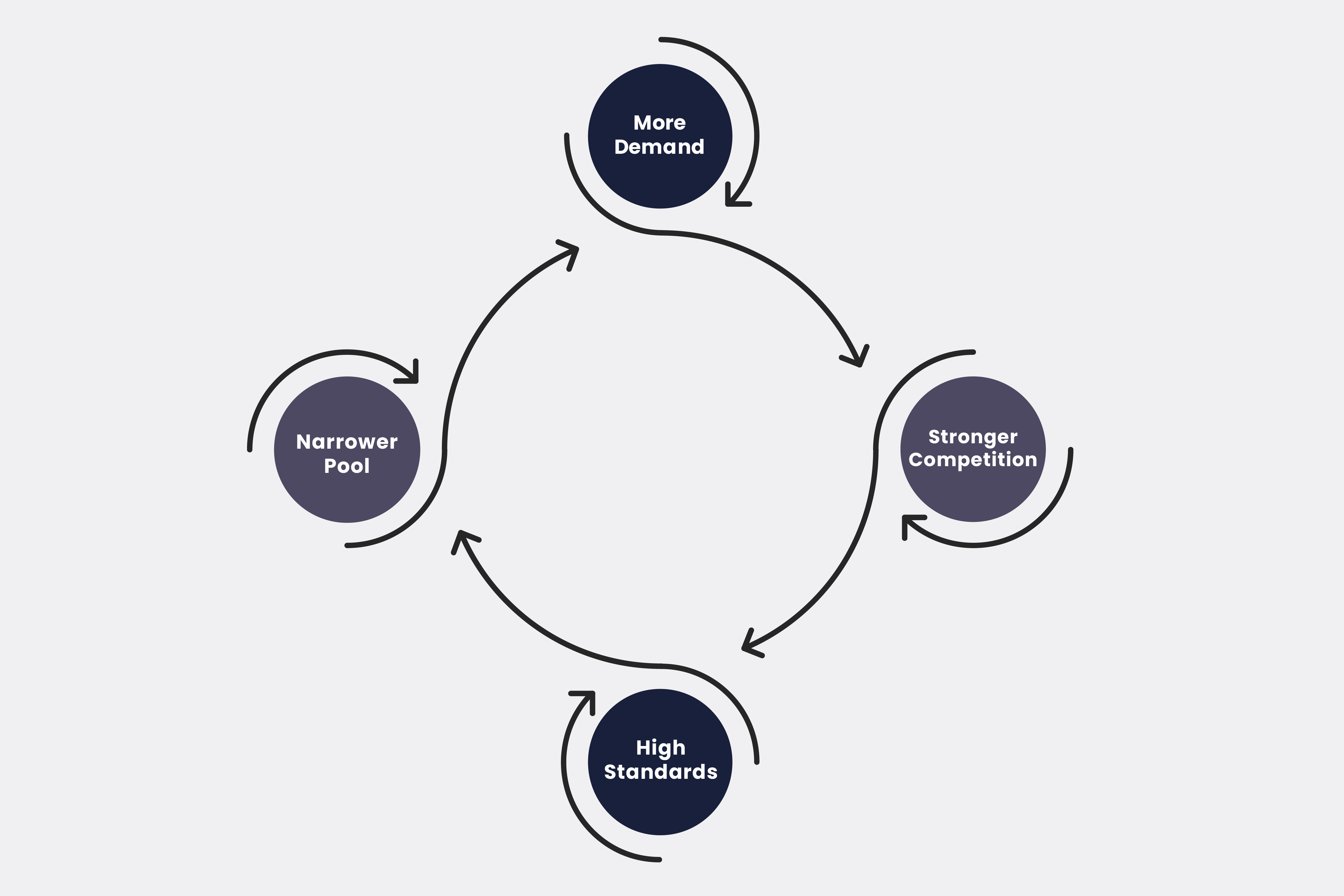
Even when layoffs increase supply, the best talent gravitates toward companies with strong brands or global reputation.
The talent mapping gap: Quality talent exists, just not where most companies look
In many regional tech hubs, engineers possess strong technical depth and a high sense of ownership. What they lack is access to global brands. This creates an alignment opportunity.
These engineers have strong fundamentals, they’re eager for challenging product work, value long-term partnerships, bring hunger and reliability, stay longer in roles, and appreciate employers they can grow with. Meanwhile, CTOs in mature markets struggle to attract talent with those traits locally.
So, the problem becomes a mapping issue, not a supply issue.
What to do instead: A better way forward
The companies that are hiring well today tend to do four things consistently:
- Broaden geography with intent – This is not “hire anywhere and hope.” It is targeted: identify regions where capability and motivation align with your role reality.
- Evaluate for ownership, not just skill – Great teams deliver great products because they care, not because someone assigned a task.
Many hiring processes detect “knowledge,” but miss “responsibility.” Make ownership visible. Ways to do that:
- Ask for one example of a self-initiated improvement shipped to production
- Test how candidates reason about tradeoffs and failure modes
- Include a short “bug-to-fix” or “system change” walkthrough with real constraints
- Build dedicated teams that feel connected to the product – Not outsourcing. Not freelancing. Dedicated product teams that integrate fully and contribute like internal staff.
- Invest in long-term partnerships – High-quality engineers rarely appear through one-off transactions. They are found through consistent ecosystems: communities, referrals, repeatable pipelines, and partners who understand your bar.
Conclusion
There is no single, universal tech talent shortage. There is a shortage of engineers with the right combination of technical depth, ownership mindset, and product thinking for the environment many CTOs operate in, especially in traditional SMEs or tech-enabled companies, where recruiting tech talent and filling open tech roles can be more challenging by enterprise size.
The market did not fail. The assumptions about where talent comes from, how it is motivated, and how it should be evaluated are what need to evolve.
Companies that adapt will hire faster, build stronger products, and avoid chasing a narrative that no longer reflects the hiring reality.